Thelwell in bronze
Equestrian sculptures for
gardens and homes
Anyone who grew up with a pony, or spent a childhood wishing they had one, will most likely be familiar with Norman Thelwell's illustrations – or at least recognise the predicaments he so often captured: a rotund, stubborn steed with its own firm ideas about the afternoon's direction, and a small rider doing everything possible to stay in the saddle.
His cartoons first appeared in Punch magazine during the 1950s. Over the decades, you could visit a stable, tack room, or riding school and safely expect to find favourite clippings pasted across the walls, while collected volumes found permanent homes on family bookshelves.
Here in the workshop, our job is to translate those expressive pen-and-ink drawings into three dimensions using solid bronze. Capturing the anatomy and spirit of the pony is always the challenge, from the existing Thelwell pony and rider in our collection to the newest addition currently taking shape…
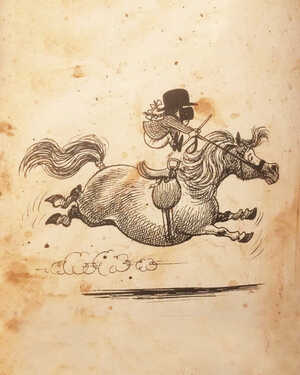
Norman Thelwell and his ponies
Thelwell drew with a keen eye for the small eccentricities of country life, with stubborn horses and ponies at the heart of his observations. Collections like Angels on Horseback gave generations of riders immediate recognition of their own weekend exploits: where a flat refusal at a fence or a pony’s sudden fascination with a hedgerow routinely left a rider clinging to a handful of mane.
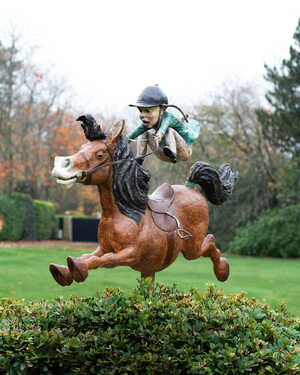
Our Thelwell Pony and Rider sculpture catches the pair mid-jump, at the exact moment the pony clears a hurdle with considerably more enthusiasm than grace. Above the saddle, the rider clings on for dear life.
Measuring approximately 75cm high and 100cm long, the sculpture begins as a clay model, hand-shaped to capture every roll of the pony's flank and the tension in the rider's posture. The original form is then cast in solid bronze using the traditional lost-wax method.
Liquid bronze is poured at extreme temperatures into a ceramic shell, which is later broken away to reveal the sculpture. From there, the piece is meticulously chased, patinated, and polished by hand. The final result is solid bronze that will happily sit out on a lawn through every season, slowly deepening in tone as it weathers over time.
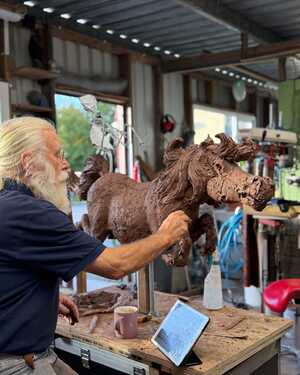
A new arrival from the collection
Work has begun on our second Thelwell character, following a conversation with one of our collectors, who already had the original Pony and Rider displayed on their lawn – and decided it was time for some competition.
The Fat Pony Race, in their words, is on.
The new piece introduces Harold, a piebald whose relationship with his rider has reached a standstill. Where the first sculpture shows a pony and rider sailing over a jump together, more or less, Harold has rather different plans.
Anyone who has tried to coax a pony past a gateway it has taken against will know the feeling.
Harold’s design ensures he sits comfortably alongside the original sculpture, turning any patch of grass into a shared, chaotic narrative.

From sketch to armature
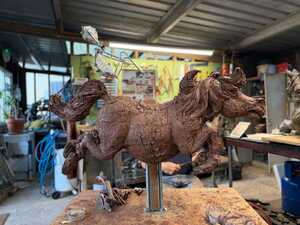
We are at the very start with Harold. The first job on any equestrian piece is proportion. A Thelwell pony is all roundness and attitude, and translating a drawn line into three dimensions means deciding how deep the barrel of the pony runs, how the weight sits through the legs, and where the rider’s balance falls. Get those wrong, and the caricature is lost.
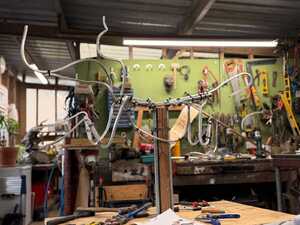
Once the proportions are settled we build the armature, the internal frame that holds the clay as the figure is modelled. From there the piece moves through the full lost-wax process.
Placing an equestrian sculpture at home or in the garden
A Thelwell pony works well anywhere it can be seen and enjoyed. Some clients place theirs on a lawn in view of the house; others near a paddock gate or stable yard, where the setting and sculpture meet on common ground. Smaller spaces work well, too, from a simple courtyard to an entrance hall.
A few practical points for outdoor pieces:
Keep the sculpture clear of large trees that may drop branches.
Bronze develops a natural verdigris patina over time. A neutral wax slows the process if you prefer to keep the original colour, and our Bronze Care Kit has everything you need.
We offer an installation service, so your piece arrives and is set in place properly.
Installation, placement and lasting care
Explore our Norman Thelwell bronze collection, or request a printed brochure to see the full range of literary sculptures and water features, with sizes and details for each piece. If you have a Thelwell scene of your own in mind, we would be glad to talk about a commission.
 Updating page...