The Water-Babies
Our Most Ambitious Water Feature Yet
If The Water-Babies fountain isn’t our most ambitious project to date, it’s certainly the largest and most intricate.
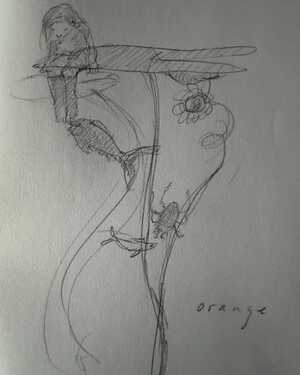
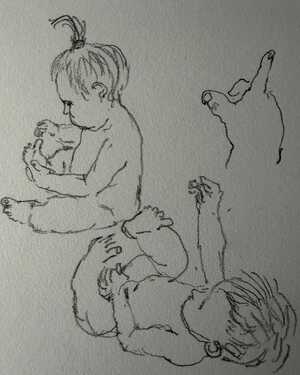
At this early stage, the daily work involves experimentation. Charting the initial lines on paper, testing the movement of water, and shaping small clay maquettes to understand how the physical weight of the structure will balance.
The project brings together a single source of inspiration, an intricate structural plan, and a timeless piece of Victorian literature that suits bronze and water perfectly.
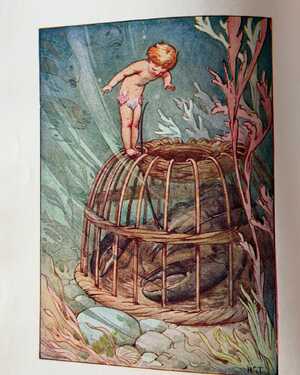
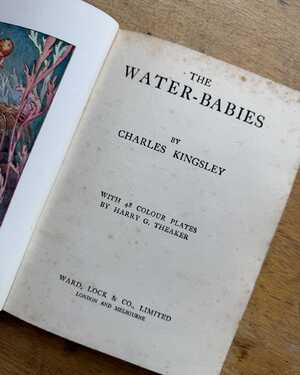
Charles Kingsley’s The Water-Babies
Charles Kingsley published The Water-Babies, A Fairy Tale for a Land-Baby in 1863. It follows Tom, a young chimney sweep who runs away from a cruel master, falls into a river and is transformed into a water-baby. Beneath the surface, he meets the creatures of the river and the sea, who guide him through a series of formative encounters.
Kingsley was a clergyman, a naturalist and a keen fisherman, and his love of rivers runs throughout the book. Caddis flies, trout, otters and dragonflies, all described by someone who had clearly spent many hours observing them. The book was a success on publication and is often credited with helping to change public feeling about the use of children as chimney sweeps.
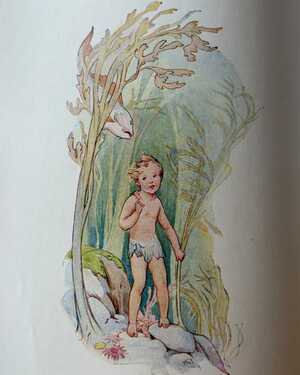
The world under the surface
For James Coplestone, the story's pull is a personal one – having been fascinated by what lies beneath the surface of water since he was a boy, a curiosity that led to a lifelong love of angling and river conservation.
The design imagines a view where larger-than-life lily pads rise high above the river on long stems that reach down to the base. Below, the riverbed is busy with life: freshwater fish, frogs and newts, water snails, and plants that spiral and grow among them. At its heart, children dance beneath a trumpet of water falling like a shower, enchanted by the nature which surrounds them.

Building a water feature of great scale
Scale, of course, brings its own challenges, and the Water-Babies has plenty.
The tallest elements, the bulrushes, will reach around five metres. The lily pads, sitting lower, around three metres above the ground, will mark the surface of an imagined river; the dancing children, surrounded by underwater life, positioned below on the riverbed. Stand at the base, and you’ll peer up through the water towards the pads floating overhead, much as Tom would have seen them.
With the pads raised on slender stems and the bulrushes climbing beyond, the piece cannot rely on a single central support. Instead, each element must brace against another for the whole structure to stand stable and upright, so the engineering has to be worked out alongside the artistry from the first sketch.
The maquettes help. Small-scale models let us test how the stems, pads and figures share their load, how the water will fall, and how the piece reads from different points around it. We’ll try plenty of ideas and set them aside before the final design emerges. We are enjoying the process immensely and will share more as the grandwater feature develops.
Bringing a story into the garden with water
The Water-Babies fountain belongs to a long-standing workshop tradition of combining moving water with classic literary illustration; sculptures that interact naturally – beautifully – with their surroundings. Indeed, there are many existing designs in our collection that inhabit such spaces with their own distinct personalities.
Mr. Jeremy Fisher captures Beatrix Potter’s gentleman frog on his fishing expeditions, while a companion piece features Jack Sharp, the spirited stickleback that shares his water.
Kenneth Grahame’s riverbank comes to life through Ratty and Mole, while The Willow Fairy brings a serene elegance to a secluded corner of the lawn.
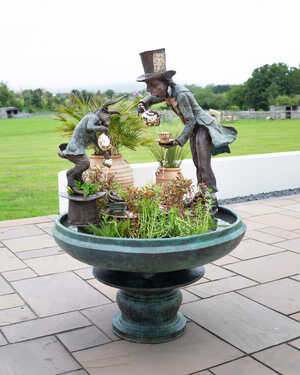
For a centrepiece of significant scale, collectors often look to the enchanting multi-character Tea Party Urn inspired by the pages of Lewis Carroll's Wonderland or the charm of the Tiger Who Came to Tea water feature.
Or, the grandest of all, the oak and bronze Pooh Sticks Bridge that recreates the classic E.H. Shepard illustration over a stream. There are many more to explore.
Our full range of water features is available to view online, and our printed brochure provides specific dimensions for planning a garden layout. Get in touch if you'd like to discuss your literary garden project.
 Updating page...